Everything you owe before your cargo leaves the port.
~ O M V R ~
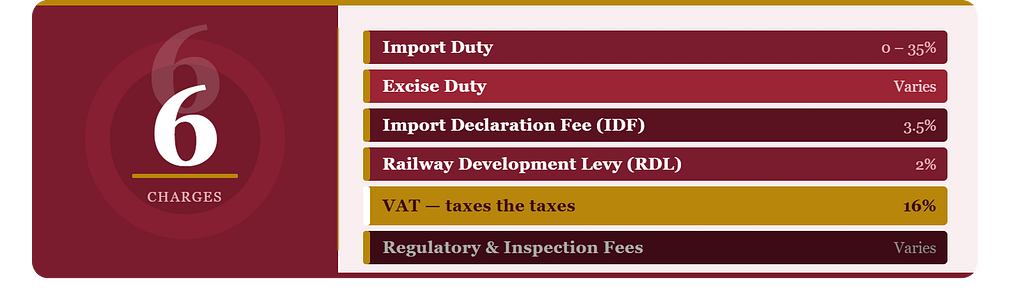
Most importers budget for duty. A few budget for VAT. Almost none budget for all six charges Kenya applies before a single container moves out of Mombasa — and that gap is where landed costs spiral.
Kenya operates within the East African Community (EAC), meaning imports follow the Common External Tariff. But the CET is just the opening act. What follows is a carefully sequenced stack of taxes, levies, and fees — each one building on the last.
The order they are applied matters as much as the rates themselves. Because in Kenya’s system, taxes compound — and VAT sits at the very top, taxing everything beneath it.
The first domino: CIF
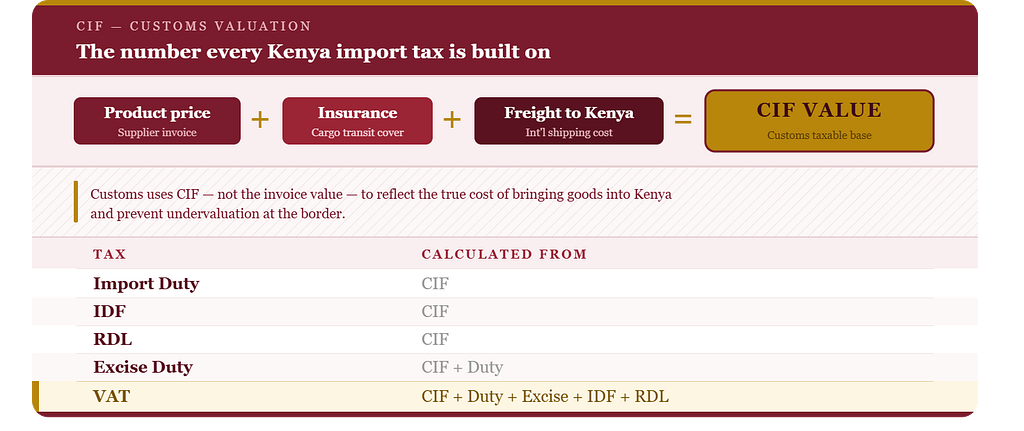
Before customs calculates a single tax, they first determine one critical number: CIF — Cost, Insurance and Freight. This is the customs value of goods when they arrive at the Kenyan port of entry. Every major import tax is calculated from it.
Related concept:
CIF is also an Incoterm — and it directly determines who builds this number
CIF doesn’t just describe a customs calculation — it’s one of eleven International Commercial Terms (Incoterms) that govern global trade. As an Incoterm, CIF (Cost, Insurance and Freight) means the seller is responsible for paying freight and insurance to the named destination port. That makes the seller the one who builds the exact figure Kenya’s customs will tax.
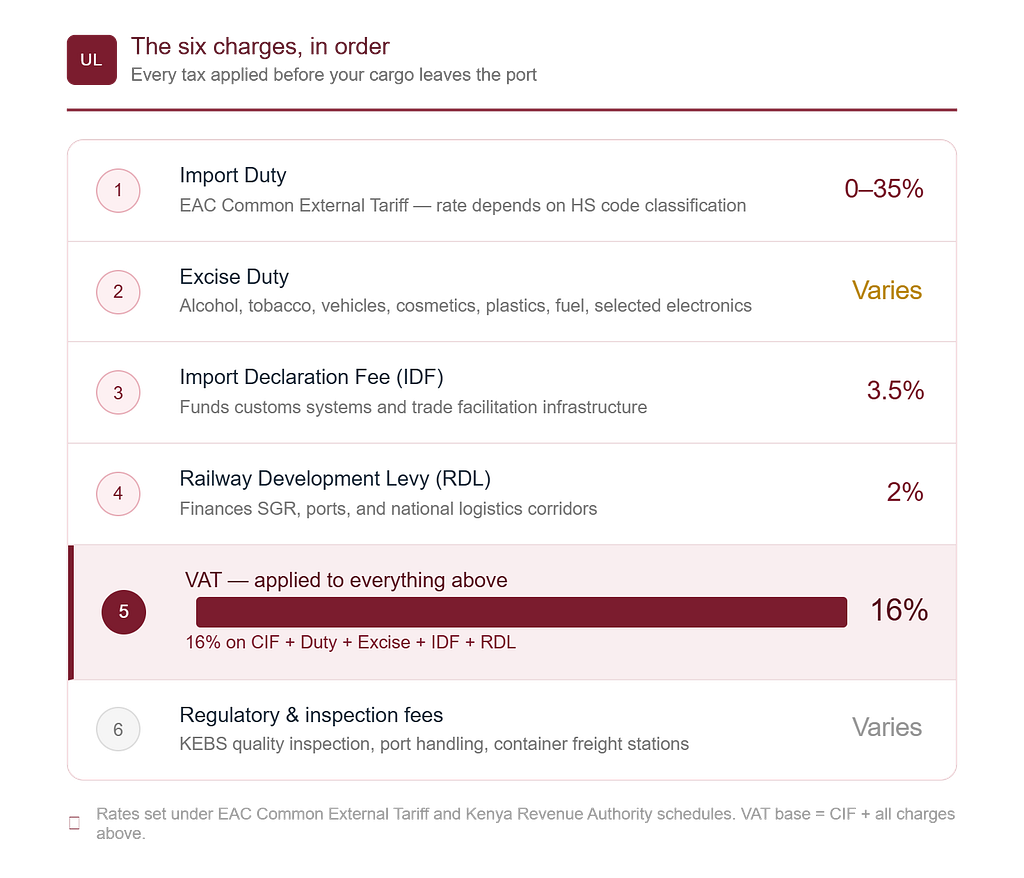
Here is every tax and levy applied to most imports into Kenya. Note where VAT sits — at the top of the stack, after everything else has already been added.
VAT doesn’t just apply to your goods. It applies to the duty, the levies, and the fees you’ve already paid — then adds 16% on top of all of it.
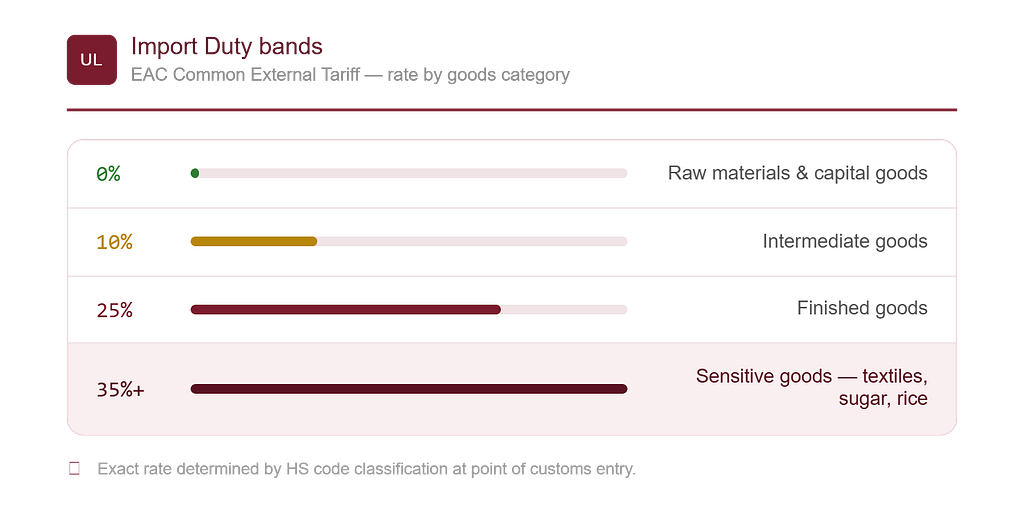
Import Duty bands
The EAC tariff structure is deliberately tiered — protecting local manufacturing while keeping raw inputs affordable for producers.
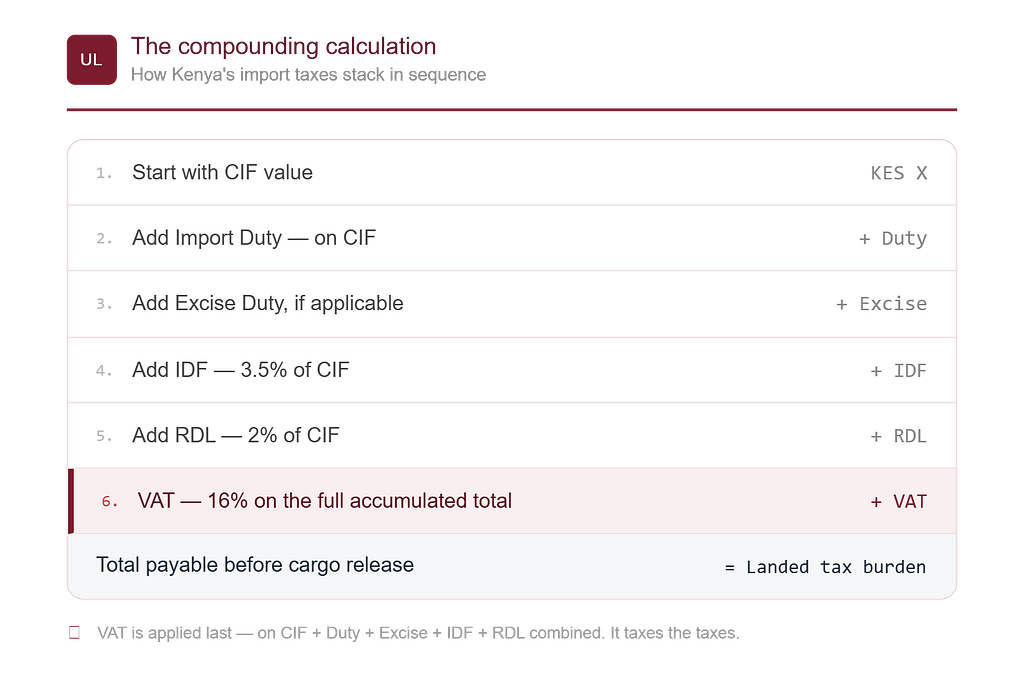
The compounding problem
This is where most importers underestimate their landed cost. The taxes don’t sit side by side — they stack vertically, each one adding to the base before the next is calculated.
By the time VAT is applied, the base includes duty, excise, IDF, and RDL. That is why the effective tax burden on finished goods frequently exceeds what a flat rate calculation would suggest.
VAT taxes the taxes. It’s applied to everything that came before it in the stack.
Why Kenya built it this way
The structure isn’t arbitrary — it serves three deliberate goals that any serious importer should understand.
Protect local industry: Tariffs make imported finished goods less competitive, giving Kenyan manufacturers room to operate.
Fund infrastructure: IDF and RDL directly finance customs modernisation, SGR, ports, and logistics corridors.
Fair domestic taxation: VAT at the border ensures imports compete on equal tax footing with locally produced goods.
The real takeaway for importers
When importing into Kenya, you are not paying a single duty rate. You are navigating a layered tax ecosystem — and every layer compounds the one before it.
Expect:
Tariffs from the EAC Common External Tariff
Infrastructure levies — IDF and RDL
Consumption taxes — VAT and Excise where applicable
Compliance and inspection fees — KEBS, port and freight handling
Understanding this stack is the difference between accurate landed cost pricing and expensive surprises at the port.
|And in logistics, surprises are the most expensive cargo of all.|
Where Expertise Matters Most
Knowing the rules is one thing. Navigating them under time pressure — with cargo sitting at the port — is another.
A misclassified HS code, an under-declared CIF value, or a missed levy can mean delays, penalties, and demurrage charges that dwarf the original tax bill.
The importer who wins on landed cost is not necessarily the one who pays the least duty — it is the one who clears cargo correctly, completely, and on time.
Our customs experts handle the stack — so you don’t have to.
At Univar Logistics, our clearing and forwarding team guides importers through every layer of Kenya’s customs requirements — from accurate HS code classification and CIF valuation to duty computation, KRA compliance, and port release. We move your cargo quickly and keep you fully compliant at every step.